To:
Keystone‑SDA Editorial Team
Roche Holding AG
CC:
Swatch Group
Richemont
Straumann Group
Sika AG
DSM‑Firmenich
Wyjaśnienie eksperckie dotyczące błędnych narracji o „silnym franku” oraz matematycznej struktury rynku walutowego
Do:
Redakcja Keystone‑SDA
DW:
Roche Holding AG
Swatch Group
Richemont
Straumann Group
Sika AG
DSM‑Firmenich
Szanowni Państwo,
piszę w nawiązaniu do artykułu „Franc’s relentless rise alarms Swiss companies” z dnia 16 lutego 2026 r., w którym opisano wpływ rzekomo „umacniającego się franka” na największe szwajcarskie firmy eksportowe.
Jako niezależny analityk finansowy z 25‑letnim doświadczeniem w analizie matematycznej struktury rynku walutowego chciałbym przedstawić krótkie, rzeczowe wyjaśnienie.
Interpretacja przedstawiona w artykule — że frank „się umacnia” — nie odzwierciedla rzeczywistego mechanizmu zmian kursu CHF.
Mechanizm ten jest matematyczny, a nie narracyjny.
1. Frank szwajcarski nie umacnia się samodzielnie
Zmiany na parze USD/CHF nie wynikają z „siły” franka.
Są matematyczną konsekwencją zmian na parze EUR/USD.
Zasada jest uniwersalna:
- gdy dolar traci do euro → euro się umacnia,
- a ponieważ frank jest strukturalnie powiązany z euro → frank również umacnia się wobec dolara.
I odwrotnie.
To nie jest interpretacja — to matematyka kursów krzyżowych.
2. Firmy wymienione w artykule reagują na słabość dolara, a nie na „siłę franka”
W artykule wskazano, że:
- Roche,
- Swatch Group,
- Richemont,
- Straumann,
- Sika,
- DSM‑Firmenich
odczuwają presję z powodu „silnego franka”.
W rzeczywistości:
Te firmy odczuwają skutki słabszego dolara, a nie silniejszego franka.
To rozróżnienie jest kluczowe dla rzetelnego opisu rynku i oceny ryzyka walutowego.
3. Przykład z realnego rynku (15 stycznia 2026)
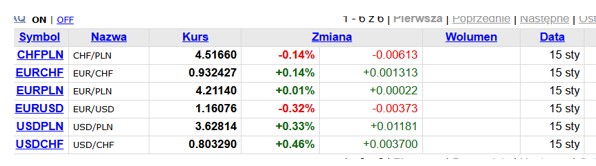
- EUR/USD = −0,32%
- EUR/CHF = +0,14%
- USD/CHF = +0,46%
Zależność matematyczna:
USD/CHF = EUR/CHF ÷ EUR/USD
0,932427 ÷ 1,16076 = 0,803290
Zmiany procentowe również się sumują:
+0,14% + +0,32% = +0,46%
To jest czysta matematyka.
4. Dzisiejsze kursy potwierdzają ten sam mechanizm
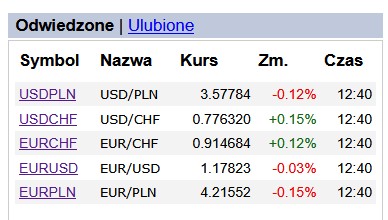
Dzisiejsze dane (12:40):
|
Para
|
Kurs
|
Zmiana
|
|
USD/PLN
|
3.57784
|
−0.12%
|
|
USD/CHF
|
0.776320
|
+0.15%
|
|
EUR/CHF
|
0.914684
|
+0.12%
|
|
EUR/USD
|
1.17823
|
−0.03%
|
|
EUR/PLN
|
4.21552
|
−0.15%
|
Interpretacja:
- USD/CHF rośnie, bo EUR/USD spada → dolar zyskuje do euro.
- EUR/CHF rośnie → frank traci do euro.
- USD/PLN spada, bo EUR/PLN spada → złoty zyskuje do euro.
Wszystkie ruchy są matematycznie spójne.
5. Główna zasada zależności walut od euro
Mechanizm zmian na rynku walutowym jest prosty i zawsze działa według tej samej logiki.
Zasada ta obowiązuje dla wszystkich walut europejskich, ponieważ euro jest walutą bazową współczesnego rynku europejskiego.
Gdy dolar traci do euro:
- euro zyskuje,
- a wraz z nim frank, złoty i inne waluty europejskie,
- każda proporcjonalnie do swojego kursu do euro.
Gdy dolar zyskuje do euro:
- euro traci,
- a wraz z nim frank, złoty i inne waluty europejskie,
- każda proporcjonalnie do swojego kursu do euro.
To nie jest „widzi mi się rynku”.
To jest matematyka kursów krzyżowych.
6. Ta sama matematyka działa dla wszystkich walut
Każda para krzyżowa powstaje z dzielenia dwóch par z euro:
- USD/PLN = EUR/PLN ÷ EUR/USD
- CHF/PLN = EUR/PLN ÷ EUR/CHF
- GBP/PLN = EUR/PLN ÷ EUR/GBP
- USD/JPY = EUR/JPY ÷ EUR/USD
- AUD/PLN = EUR/PLN ÷ EUR/AUD
Zmiana procentowa pary krzyżowej ≈
zmiana procentowa pary A
+
zmiana procentowa pary B (odwrócona)
To działa zawsze, bo to czysta matematyka.
7. Mit „bezpiecznego franka” jest przestarzały
Mit powstał w czasach, gdy Europa miała wiele niezależnych walut.
Dziś:
- euro jest gigantem,
- frank jest walutą małą i podatną na skoki,
- Szwajcaria nie koryguje mitu,
- inwestorzy wciąż wierzą w „bezpieczną przystań”.
To milczenie jest ryzykowne.
8. Szwajcaria była o krok od załamania w 2015 roku
Po uwolnieniu kursu EUR/CHF frank skoczył o 30% w kilka minut.
W tym momencie:
- rynek przestał działać,
- eksport był na krawędzi,
- firmy były blisko bankructwa,
- banki miały gigantyczne ryzyko,
- gospodarka była o krok od katastrofy.
Bez ogromnych rezerw SNB frank mógłby umocnić się o 50–70%.
To oznaczałoby:
- załamanie eksportu,
- masowe zwolnienia,
- upadłość banków,
- głęboki kryzys gospodarczy.
Ten epizod obala mit „bezpiecznego franka”.
9. Dlaczego euro jest realną tarczą bezpieczeństwa
Euro:
- eliminuje ryzyko kursowe,
- stabilizuje ceny,
- obniża koszty kredytów,
- chroni przed spekulacją,
- zapewnia przewidywalność,
- usuwa konieczność bronienia waluty rezerwami,
- stabilizuje gospodarki w kryzysach globalnych.
W praktyce:
CHF jest stabilny dlatego, że stabilne jest euro — nie dlatego, że frank jest „silny”.
10. Problem systemowy: narracje medialne oparte na depeszach agencji
Swissinfo potwierdziło, że:
- nie tworzy własnych analiz walutowych,
- artykuły o CHF pochodzą z Keystone‑SDA,
- media publikują je automatycznie, bez weryfikacji.
To oznacza, że:
Jedna błędna narracja agencji staje się narracją całej Europy — bez analizy, bez matematyki, bez kontekstu.
11. Jestem dostępny do komentarza eksperckiego
Chętnie udzielę:
- szerszej analizy,
- wyjaśnienia tła,
- krótkiego komentarza lub wywiadu.
Moje pełne opracowania są dostępne tutaj:
https://michal-asman.manifo.com/sekcja-walutowa
Z poważaniem,
Michał Asman
Niezależny analityk finansowy
Dear Editorial Team,
I am writing in reference to your article “Franc’s relentless rise alarms Swiss companies” published on 16 February 2026, which describes the impact of a supposedly “strengthening franc” on major Swiss exporters.
As an independent financial analyst with 25 years of experience in the mathematical structure of the currency market, I would like to provide a concise and factual clarification.
The interpretation presented in the article — that the franc is “strengthening” — does not reflect the actual mechanism behind CHF movements.
This mechanism is mathematical, not narrative.
1. The Swiss franc does not strengthen independently
Movements in USD/CHF do not result from the intrinsic strength of the franc.
They are a mathematical consequence of movements in EUR/USD.
The universal rule is:
- when the US dollar loses value against the euro → the euro strengthens,
- and because the franc is structurally tied to the euro → the franc strengthens against the dollar as well.
And vice versa.
This is not interpretation — it is the mathematics of cross‑currency rates.
2. The companies mentioned in the article are reacting to USD weakness, not CHF strength
Your article states that:
- Roche,
- Swatch Group,
- Richemont,
- Straumann,
- Sika,
- DSM‑Firmenich
are under pressure due to a “strong franc”.
In reality:
These companies are experiencing the effects of a weaker US dollar, not a stronger Swiss franc.
This distinction is essential for accurate reporting and proper currency‑risk assessment.
3. Real‑market example (15 January 2026)
- EUR/USD = −0.32%
- EUR/CHF = +0.14%
- USD/CHF = +0.46%
Mathematical relationship:
USD/CHF = EUR/CHF ÷ EUR/USD
0,932427 ÷ 1,16076 = 0,803290
Percentage changes also add up:
+0,14% + +0,32% = +0,46%
This is pure mathematics.
4. Today’s exchange rates confirm the same mechanism
Today’s data 23.02.2026 (12:40) http://www.stooq.pl :
|
Pair
|
Rate
|
Change
|
|
USD/PLN
|
3.57784
|
−0.12%
|
|
USD/CHF
|
0.776320
|
+0.15%
|
|
EUR/CHF
|
0.914684
|
+0.12%
|
|
EUR/USD
|
1.17823
|
−0.03%
|
|
EUR/PLN
|
4.21552
|
−0.15%
|
Interpretation:
- USD/CHF rises because EUR/USD falls → the dollar gains against the euro.
- EUR/CHF rises → the franc weakens against the euro.
- USD/PLN falls because EUR/PLN falls → the zloty strengthens against the euro.
All movements are mathematically consistent.
5. The main rule governing European currencies
The mechanism of currency movements is simple and always follows the same logic.
This rule applies to all European currencies because the euro is the base currency of the modern European market.
When the dollar loses value against the euro:
- the euro strengthens,
- and so do the franc, the zloty and other European currencies,
- each proportionally to its exchange rate with the euro.
When the dollar gains value against the euro:
- the euro weakens,
- and so do the franc, the zloty and other European currencies,
- each proportionally to its exchange rate with the euro.
This is not “market sentiment”.
This is the mathematics of cross‑currency rates.
6. The same mathematics applies to all currencies
Every cross‑currency pair is created by dividing two euro‑based pairs:
- USD/PLN = EUR/PLN ÷ EUR/USD
- CHF/PLN = EUR/PLN ÷ EUR/CHF
- GBP/PLN = EUR/PLN ÷ EUR/GBP
- USD/JPY = EUR/JPY ÷ EUR/USD
- AUD/PLN = EUR/PLN ÷ EUR/AUD
Percentage change of a cross pair ≈
percentage change of pair A
+
percentage change of pair B (inverted)
This always works because it is pure mathematics.
7. The “safe‑haven franc” narrative is outdated
The myth originated when Europe had many independent currencies.
Today:
- the euro is the dominant regional currency,
- the franc is small and highly reactive,
- Switzerland does not correct the myth,
- investors still believe in a “safe haven”.
This silence is risky.
8. Switzerland was close to collapse in 2015
After the SNB removed the EUR/CHF floor, the franc jumped 30% within minutes.
At that moment:
- the market stopped functioning,
- exports were on the brink of collapse,
- companies were close to bankruptcy,
- banks carried enormous risk,
- the economy was near systemic failure.
Without SNB’s massive reserves, the franc could have strengthened by 50–70%.
This would have meant:
- collapse of exports,
- mass layoffs,
- bank failures,
- deep economic crisis.
This episode disproves the “safe‑haven franc” myth.
9. Why the euro is the real stabilizing force
The euro:
- eliminates exchange‑rate risk,
- stabilizes prices,
- lowers credit costs,
- protects against speculation,
- provides predictability,
- removes the need to defend a currency with reserves,
- stabilizes economies during global crises.
In practice:
The franc is stable because the euro is stable — not because CHF is inherently strong.
10. A systemic issue: media narratives based on agency feeds
Swissinfo has confirmed that:
- it does not produce its own currency analysis,
- articles about CHF come directly from Keystone‑SDA,
- media publish them automatically without verification.
This means:
One incorrect agency narrative becomes the narrative of all Europe — without analysis, without mathematics, without context.
11. I remain available for expert commentary
I would be pleased to provide:
- a more detailed analysis,
- background explanation,
- or a short expert interview.
My full work is available here:
https://michal-asman.manifo.com/sekcja-walutowa
Kind regards,
Michal Asman
Independent Financial Analyst