Michał Asman
European Central Bank
Sonnemannstrasse 20
60314 Frankfurt am Main
Germany
5 February 2026
Opracowanie dotyczące matematycznych zależności walutowych oraz błędnych narracji medialnych w Europie
Szanowni Państwo,
zwracam się do Państwa z uprzejmą prośbą o zapoznanie się z załączonym opracowaniem dotyczącym matematycznej struktury kursów walutowych w Europie oraz problemu błędnych narracji medialnych, które powstają na poziomie agencji informacyjnych i są automatycznie powielane przez media w całej Unii Europejskiej.
Impulsem do przygotowania opracowania była oficjalna odpowiedź redakcji Swissinfo (SWI), która potwierdziła, że publikowane przez nich treści dotyczące „umacniania się franka” pochodzą z agencji Keystone‑SDA i nie są weryfikowane pod kątem zgodności z rzeczywistą logiką rynku walutowego.
Oznacza to, że jedna błędna narracja agencji informacyjnej staje się narracją całej Europy — bez analizy, bez matematyki, bez kontekstu.
1. Matematyczna struktura rynku walutowego — przykład z realnych danych
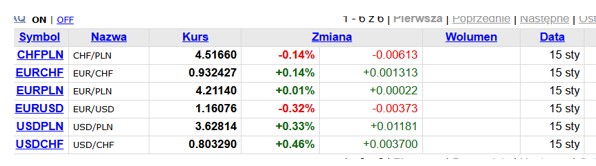
Poniższy przykład z 15 stycznia 2026 r. pokazuje, jak działa współczesny rynek walutowy:
- EUR/USD = 1,16076 → zmiana: −0,32%
- EUR/CHF = 0,932427 → zmiana: +0,14%
- USD/CHF = 0,803290 → zmiana: +0,46%
Kurs USD/CHF wynika z zależności:
USD/CHF = EUR/CHF ÷ EUR/USD
czyli:
0,932427 ÷ 1,16076 = 0,803290
Wartości liczbowe zgadzają się idealnie.
Jak to działa procentowo?
Krok 1 — EUR/CHF: +0,14%
Euro zyskuje do franka → frank traci do euro.
Krok 2 — EUR/USD: −0,32%
Euro traci do dolara → dolar zyskuje do euro.
Zmiana odwrotna: +0,32% dla USD.
Krok 3 — USD/CHF = suma zmian procentowych
+0,14% + +0,32% = +0,46%
Dokładnie tyle, ile pokazuje rynek.
Co to oznacza?
- zmiany procentowe w kursach krzyżowych dodają się lub odejmują logicznie,
- nie trzeba zgadywać — wystarczy znać dwie pary,
- działa to zawsze, na każdej walucie,
- to matematyka rynku, nie interpretacja.
2. Jak działa świat walut — logika dla każdego
Waluty nie funkcjonują w próżni.
Są jak trybiki w jednym mechanizmie.
Najważniejszy trybik w Europie to euro.
Złoty, frank i inne waluty reagują na euro — a nie odwrotnie.
To nie magia.
To nie polityka.
To matematyka i proporcje między parami walutowymi.
3. Złoty i inne waluty — zależne od euro
Złoty działa jak wagon doczepiony do lokomotywy euro.
Gdzie jedzie euro → tam jedzie złoty.
Ale jak szybko i jak mocno — zależy od jego kursu do euro.
To z kolei zależy od:
- stanu polskiej gospodarki,
- lokalnych nastrojów politycznych.
4. Główna zasada zależności walut od euro
Mechanizm zmian na rynku walutowym jest prosty i zawsze działa według tej samej logiki.
Zasada ta obowiązuje dla wszystkich walut, ponieważ euro jest walutą bazową współczesnego rynku europejskiego.
1. Gdy dolar traci do euro:
- euro zyskuje,
- a skoro euro zyskuje, to frank, złoty i inne waluty europejskie również zyskują,
- każda proporcjonalnie od swojego kursu do euro.
2. Gdy dolar zyskuje do euro:
- euro traci,
- a wraz z nim frank, złoty i inne waluty europejskie również tracą,
- każda proporcjonalnie od swojego kursu do euro.
To nie jest interpretacja.
To matematyka kursów krzyżowych, która działa zawsze.
Skala zależy od relacji PLN, CHF i innych walut do euro:
czy rośnie, spada, czy stoi w miejscu.
To nie jest „widzi mi się rynku”.
To jest matematyka.
5. Frank szwajcarski nie jest „bezpieczną przystanią”
Współczesny CHF:
- nie jest walutą dominującą,
- nie jest walutą o dużych obrotach,
- nie jest walutą niezależną,
- jest walutą wtórną wobec euro.
Ruchy CHF odzwierciedlają zmiany na EUR/USD, a nie przepływy kapitału.
6. Problem systemowy: błędne narracje medialne
Swissinfo potwierdziło, że:
- redakcja nie tworzy treści o franku,
- artykuły pochodzą z agencji Keystone‑SDA,
- media publikują je automatycznie,
- jeśli agencja zmieni treść, wszystkie portale zmienią ją automatycznie.
To oznacza, że:
jedna błędna narracja agencji informacyjnej staje się narracją całej Europy.
Bez weryfikacji.
Bez analizy.
Bez matematyki.
7. Cel opracowania
Uważam, że uporządkowanie narracji medialnej dotyczącej walut europejskich — w oparciu o faktyczną strukturę rynku — leży w interesie stabilności informacyjnej, edukacyjnej i ekonomicznej.
Pełne opracowania publikuję tutaj:
https://michal-asman.manifo.com/sekcja-walutowa
Pozostaję do dyspozycji w przypadku potrzeby dodatkowych wyjaśnień lub konsultacji.
Z wyrazami szacunku,
Michał Asman
Niezależny analityk finansowy
Michal Asman
michal-asman.manifo.com
European Central Bank
Sonnemannstrasse 20
60314 Frankfurt am Main
Germany
5 February 2026
Report on the Mathematical Structure of Currency Relationships and the Issue of Misleading Media Narratives in Europe
Dear Sir or Madam,
I kindly request that you review the attached report concerning the mathematical structure of currency exchange rates in Europe and the problem of misleading media narratives, which originate at the level of news agencies and are automatically reproduced by media outlets across the European Union.
This report was prompted by an official response from the editorial team of Swissinfo (SWI), who confirmed that the content they published regarding the “strengthening of the Swiss franc” originated from the Keystone‑SDA news agency and was not verified for consistency with the actual mechanics of the currency market.
This means that a single incorrect narrative produced by a news agency becomes the narrative of the entire continent — without analysis, without mathematics, without context.
1. Mathematical structure of the currency market — real data example
The following example from 15 January 2026 illustrates how the modern currency market functions:
- EUR/USD = 1.16076 → change: −0.32%
- EUR/CHF = 0.932427 → change: +0.14%
- USD/CHF = 0.803290 → change: +0.46%
The USD/CHF rate is derived from the relationship:
USD/CHF = EUR/CHF ÷ EUR/USD
that is:
0.932427 ÷ 1.16076 = 0.803290
The numerical values match perfectly.
How this works in percentage terms
Step 1 — EUR/CHF: +0.14%
The euro strengthens against the franc → the franc weakens against the euro.
Step 2 — EUR/USD: −0.32%
The euro weakens against the dollar → the dollar strengthens against the euro.
Reverse change: +0.32% for USD.
Step 3 — USD/CHF = sum of percentage changes
+0.14% + +0.32% = +0.46%
Exactly as shown by the market.
What this means
- percentage changes in cross‑currency pairs add or subtract logically,
- no guessing is required — knowing two EUR‑based pairs is enough,
- this mechanism works for every currency,
- it is market mathematics, not interpretation.
2. How the currency system works — logic for everyone
Currencies do not operate in isolation.
They function like interconnected gears in a single mechanism.
The most important gear in Europe is the euro.
The Polish zloty, the Swiss franc and other European currencies react to the euro — not the other way around.
This is not magic.
This is not politics.
This is mathematics and proportionality between currency pairs.
3. The zloty and other currencies — dependent on the euro
The Polish zloty behaves like a wagon attached to the locomotive of the euro.
Where the euro goes → the zloty follows.
The speed and scale of movement depend on its exchange rate to the euro.
This, in turn, depends on:
- the condition of the domestic economy,
- local political sentiment.
4. The main rule of currency dependence on the euro
The mechanism of currency movements is simple and always follows the same logic.
This rule applies to all European currencies because the euro is the base currency of the modern European market.
1. When the dollar weakens against the euro:
- the euro strengthens,
- and as the euro strengthens, the franc, the zloty and other European currencies strengthen as well,
- each proportionally according to its exchange rate to the euro.
2. When the dollar strengthens against the euro:
- the euro weakens,
- and the franc, the zloty and other European currencies weaken as well,
- each proportionally according to its exchange rate to the euro.
This is not interpretation.
This is the mathematics of cross‑currency rates, which always holds.
The scale depends on the relationship of PLN, CHF and other currencies to the euro:
whether they are rising, falling or stable.
5. The Swiss franc is not a “safe haven”
The modern CHF:
- is not a dominant currency,
- is not a high‑volume currency,
- is not an independent currency,
- is a secondary currency dependent on the euro.
Movements in CHF reflect changes in EUR/USD, not capital flows.
6. Systemic problem: misleading media narratives
Swissinfo confirmed that:
- the editorial team does not create content about the franc,
- articles originate from Keystone‑SDA,
- media outlets publish them automatically,
- if the agency updates the content, all portals update automatically.
This means:
a single incorrect narrative produced by a news agency becomes the narrative of all Europe.
Without verification.
Without analysis.
Without mathematics.
7. Purpose of this report
I believe that improving the accuracy of media narratives regarding European currencies — based on the actual mathematical structure of the market — is in the interest of informational, educational and economic stability.
My full analyses are available here:
https://michal-asman.manifo.com/sekcja-walutowa
I remain at your disposal for further clarification or consultation.
Yours sincerely,
Michal Asman
Independent Financial Analyst